


Squash 57

Updated: May 13
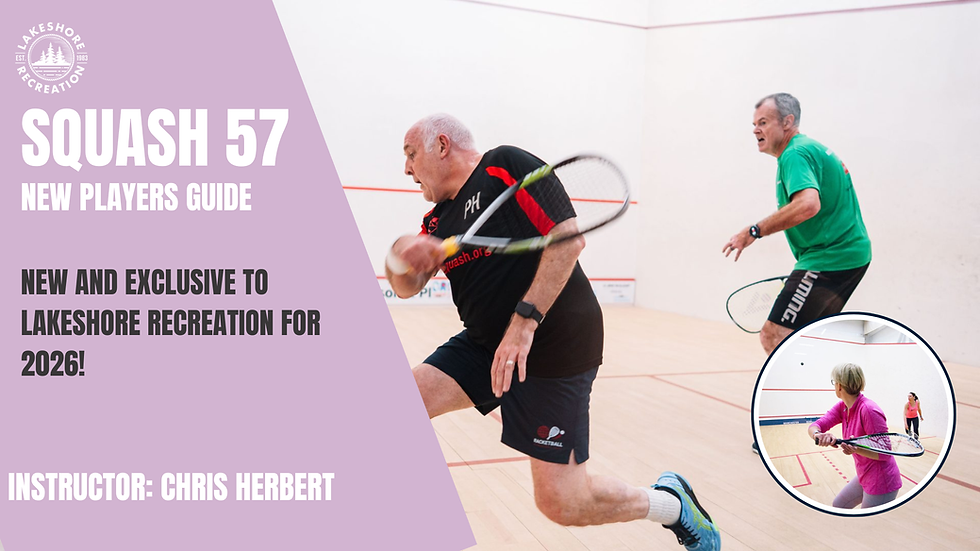
This guide is available as a PDF download here.
Welcome to Squash 57: A New Players Guide to the Game
1.0 Introduction: Welcome to the Court
Welcome to the exciting game of Squash 57!
To get the most out of your time on court, it's essential to understand the fundamentals of the game.
Squash 57 is a dynamic, accessible, and social sport designed for longer, more strategic rallies, providing a fantastic aerobic workout for all skill levels.

Squash 57 was formerly known as "Racketball." In 2016, the sport was officially rebranded as Squash 57 to better highlight its close connection to the squash family of sports, which it shares a court with.
The name '57' comes directly from the ball itself. The ball used in Squash 57 can have a maximum diameter of 57 mm.
This makes it significantly larger and bouncier than a standard squash ball, which is the key reason why rallies are often longer and more strategic, making it an excellent game for players of all abilities.
Let's begin by exploring the foundational principles that guide every match.

2.0 The Spirit of the Game: Our Guiding Principles
To truly enjoy Squash 57, it's essential to understand its core philosophy.
All the specific rules of the game are built upon three fundamental principles that ensure every match is safe, enjoyable, and fair for both players.
Playing in the right spirit is what makes our community great.

The three core principles are:
Safety: The non-striker clears a path so the striker can play safely. Protective eyeware is recommended.
Continuous: The striker plays the ball whenever it is safe to do so.
Fair: Leave decisions to the official(s) - or agree calmly in friendly play.
These principles directly inform how we play and interact on the court, starting with the most basic element of competition: the score.
3.0 Understanding the Scoreboard: How to Win
Squash 57 uses the modern "point-a-rally" (PAR) scoring system, which makes every single point count.
This creates exciting and competitive matches where the momentum can shift at any moment, regardless of who is serving.

Here’s how points, games, and matches are won:
Scoring System: A point is scored on every single rally, regardless of which player served.
Winning a Point: You win a point whenever your opponent makes an error, such as serving incorrectly or being unable to return your shot legally.
Winning a Game: The first player to reach 11 points wins the game.
The "Win by Two" Rule: If the score reaches 10-10, play does not stop. It continues until one player establishes a two-point lead (e.g., 12-10, 13-11, etc.).
Winning the Match: A match is typically the best of 3 or best of 5 games. It's important to agree with your opponent on the match length before you start playing.
Now that you understand how a game is won, let's look at how each point begins.
4.0 Mastering the Fundamentals of Play
While strategy and skill are developed over time, all play is governed by a clear set of rules for starting and continuing a rally.
Mastering these fundamentals is the key to building consistency and enjoying your matches.

4.1 The Serve: Starting the Point
The serve is the start of every rally and your first opportunity to take control of the point. If you win a rally, you continue serving for the next point, but you must switch to the opposite service box. This continues for as long as you keep winning points.
Your 3-Step Serving Sequence
Choose a side: Start the game from either service box. After each point you win, you must serve from the other box.
Feet in the box: When you make contact with the ball, at least one of your feet must be fully inside the service box, not touching any of the lines.
Bounce then strike: Drop or throw the ball and let it bounce once on the floor. Then, strike the ball so it hits the front wall above the tin and below the out line. After hitting the front wall, the ball's first bounce must land in the back quarter of the court opposite to your service box.
Common Serving Faults Be aware of these common errors. If you commit two consecutive faults, you lose the point.
Foot-fault: Your foot touches a service box line as you make contact with the ball.
Wrong landing: The ball's first bounce after hitting the front wall lands on or outside the short line or the half-court line.
Wall foul: The ball hits the back wall before it bounces. (Hitting a side wall first is okay.)
4.2 The Rally: Keeping the Point Alive
After a successful serve, players alternate hitting the ball until one player fails to make a good return. A "good return" is the foundation of every rally.
To make a good return, your shot must meet these three conditions:
Before the second bounce: The ball must be struck before it bounces twice on the floor.
To the front wall: Your shot must hit the front wall directly (or after hitting a side/back wall) at a point above the tin and below the out line.
Clean hit: The ball must be struck only once. It cannot touch you or your clothing before it reaches the front wall.
Now that we've covered the mechanics of hitting the ball, we need to address the critical rules that govern how players move around each other on the court.
5.0 Navigating On-Court Interactions: Lets, Strokes, and Safety
Squash 57 is played on a shared court, which demands constant awareness of your opponent's position.
The rules for interference are designed primarily to ensure safety and fair play. After you hit the ball, you have a direct responsibility to get out of your opponent's way and allow them to play their shot. Eye protection is recommended.

After playing a ball, you must make every effort to clear and provide your opponent with:
A fair view of the ball.
Unimpeded access to the ball.
The freedom to swing and hit the ball directly to the front wall.
When interference does occur, play stops and a decision is made. The two most common outcomes are a "Let" or a "Stroke".
Decision | What it means | Common reason |
Let | The rally is replayed. The server serves from the same box. | Interference was accidental and the non-striker made every effort to clear. |
Stroke | You win the point. | Your opponent did not clear, or prevented a clear winning shot. |
COACH'S TIP 💡
"When in doubt, prioritize safety. Stop and replay (a Let) rather than risk injury."
Important Safety Rule If your shot hits your opponent before it reaches the front wall, you will usually win the point (a Stroke) if the shot would have been good and was going directly to the front wall.
These rules of interference are part of a broader standard of behavior expected on the court.
6.0 Squash 57 On-Court Conduct & Club Etiquette
Beyond the formal rules, Lakeshore Recreation thrives on a shared etiquette that creates a respectful, positive, and enjoyable environment for all members.
This is about more than just winning or losing; it's about how we play the game.

Warm-up: A 5-minute warm-up period is shared fairly before the match begins, allowing both players an equal opportunity to hit the ball and prepare for play.
Intervals: A 90-second interval is permitted between games. Be ready to play when the time is up and always strive to keep the game moving by avoiding unnecessary delays.
Safety First: Player safety is paramount. A Let may be allowed if you refrain from hitting the ball because you fear injuring your opponent with either the ball or your racket. Eye protection is strongly recommended.
Respect: Show respect for your opponent at all times. Abuse, intentional distraction, or arguing are not welcome. Keep it friendly and focus on the sport.
We are thrilled to have you with us and look forward to seeing you on the court.
Ready to play? Serve, rally, clear, and enjoy the game!


Comments